
Technology & Monozukuri
- Basic Concept of Technology Development
- Structure for Advancing the Technology Strategy
- Evolving Technology Strategy
- AI Utilization and Risk Management
- Indicators and Goals
- Contribution to Society through Technology
Basic Concept of Technology Development
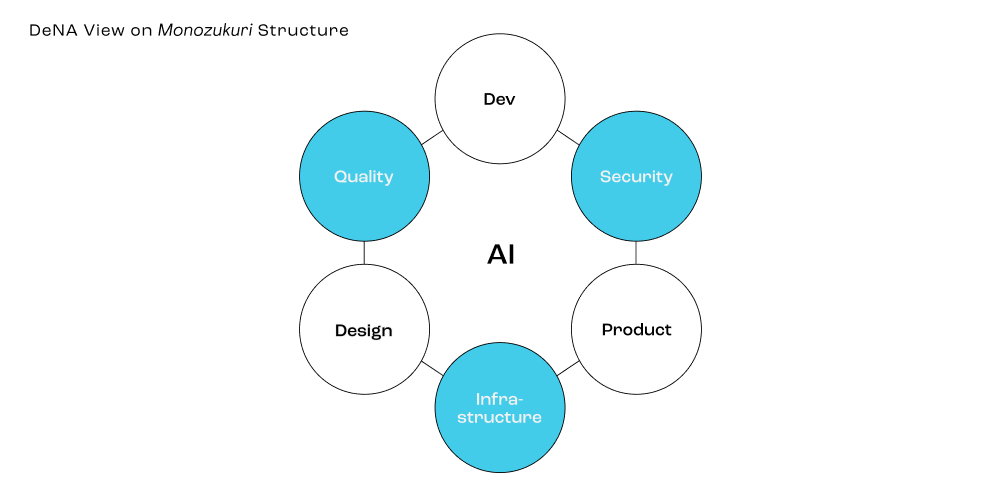
DeNA's monozukuri (product development) structure is realized through the comprehensive strength of six mutually reinforcing elements: the commonly cited Product, Design, and Development, together with three additional elements—Quality (quality management), Infrastructure, and Security. Since its founding, DeNA has cultivated this monozukuri structure alongside a thoroughgoing service orientation, and has particularly established, as one of its strengths, a robust foundation in security and infrastructure built by dedicated specialist teams.
Today, DeNA has deeply embedded AI as an indispensable element across all of these areas, dramatically strengthening and updating each activity and redefining the way the company approaches technology development.
Product
Research and market understanding have been accelerated and deepened by AI, dramatically streamlining the gathering, organizing, and output of information. Simulations of business strategies and verification plans have also become faster and more precise, supporting swift decision-making. In addition, prototyping using Vibe Coding has enabled rapid hypothesis-testing cycle.
Design
AI has expanded the role of designers. Their role has broadened to include what is known as the "Builder" domain, which significantly reduces production costs by combining various AI design tools, as well as the "Prototyper" role, which enables rapid trial and error—"thinking by making"—in collaboration with AI, improving both the quality and quantity of design output.
Development
All engineers are now fully equipped, having deployed AI-assisted development tools (Cursor, GitHub Copilot, Devin, Claude Code, Codex, and others) company-wide, dramatically improving development efficiency. These engineers are strongly driving DeNA's transition to an "AI-native company" that restructures its workflows on the premise of AI use.
Quality
Based on the philosophy that "quality is built in by everyone," DeNA has introduced AI into the processes of the development cycle, aiming for the continuous optimization of Q (Quality), C (Cost), and D (Delivery). Upstream, AI predicts risks and proposes effective test perspectives, achieving high quality while reducing rework costs; downstream, AI automatically generates test cases to reduce man-hours and accelerate the development cycle.
Infrastructure
DeNA stably operates a large-scale system that handles approximately 15 billion requests per day and hold petabyte-scale volumes of data. To maintain the reliability of the large-scale system, we have introduced Observability and AIOps for round-the-clock monitoring and immediate response to incidents, achieving faster anomaly detection and root cause analysis (RCA).
By entrusting AI with trend analysis of vast volumes of logs and metrics, DeNA has automated and advanced its operations, enabling faster and more accurate decision-making.
Security
DeNA actively utilizes in-house-developed AI to achieve security governance. An AI assistant trained on internal regulations and rules creates an environment in which employees can casually ask any question, embedding security awareness throughout the organization. In addition, AI automates the safety assessment of tools and other items being introduced, enabling rapid safety verification that does not halt business operations. Through this co-creation with AI—a form of "proactive security"—DeNA supports safe challenge-taking and growth.
Governance: Structure for Advancing the Technology Strategy
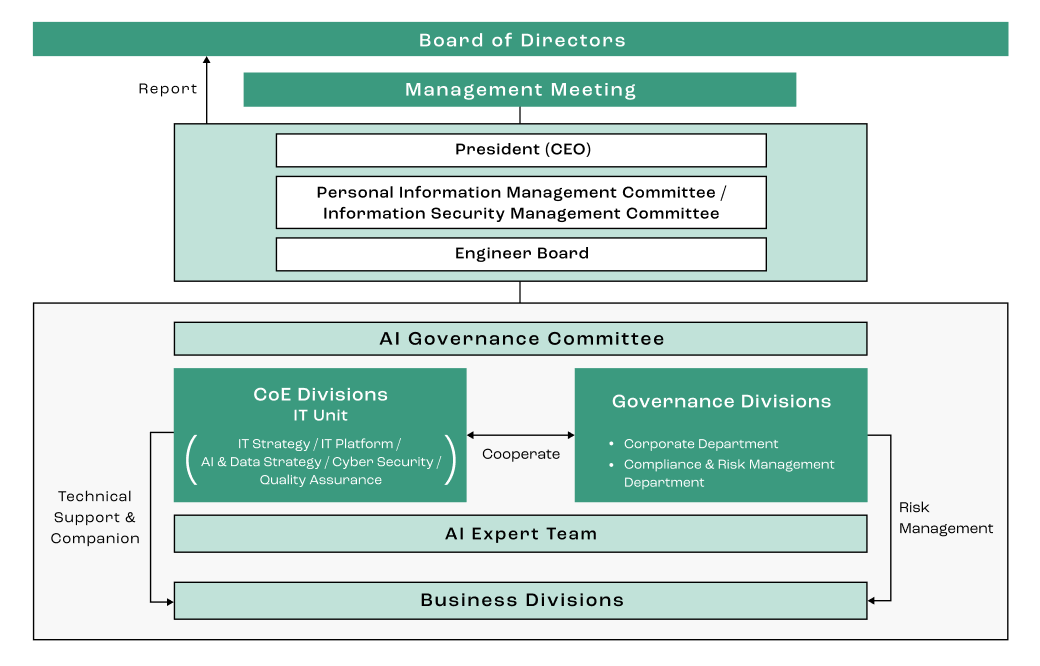
DeNA's technology strategy, including its AI strategy, is driven by three closely coordinated layers, each fulfilling its own role: "Business Divisions," directly tied to each business domain; the "CoE Divisions," which consolidates and advances technology company-wide; and the "Governance Divisions," which manages risk through independent expertise. Since its founding, DeNA has pursued monozukuri through close collaboration between its business divisions and cross-organizational functions, building a particular strength in risk management and security through dedicated teams and committees. Today, this governance structure has been embedded as the foundation for executing the company-wide AI strategy, closely linked with the Board of Directors and Management Meeting, achieving both safety and business speed at a high level.
Technology Management Structure
Our technology management functions through two pillars: the GEX serving as Technology Owner for each business, and the cross-business CoE. The "Engineer Board," composed of both, deliberates and decides on company-wide technology matters, including key policies. Meanwhile, the role of examining individual technology topics in greater depth is handled by working groups set up for each theme, creating a structure that advances both company-wide decision-making and specialized, front-line-oriented deliberation, each at the appropriate level of granularity.
■Promotion Structure Chart
The Importance of the CoE (Center of Excellence)
The IT Unit is not merely an internal IT department, but a "CoE" providing company-wide capabilities that forms the foundation of monozukuri. By concentrating functions here rather than distributing them across business divisions, DeNA drives major company-wide transformation with speed — one of its great strengths. In each business area, a "Business Owner" and "Technology Owner" enforce company-wide governance and manage business-specific risks, while the CoE acts as a "companion," solving each business's unique challenges.
AI: Offense and Defense
- AI Expert Team
The AI Expert Team, which combines expertise in AI with knowledge of our business domains, drives the use of AI across the entire company. Overall oversight is provided by the Head of the IT Unit and the Group Executive (GEX) for AI promotion, and the team comprises around 150 members, including specialists in engineering, legal, quality management, security, and each business division. In addition, a dedicated team of approximately 30 engineers continuously evaluates the latest AI tools.
Beyond evaluating tools, this team also functions as a command center, agilely handling everything from planning and prioritizing and approaches to selection, development, and operation, drawing on its accumulated AI expertise and practical know-how. A key distinguishing feature is that the team places importance not only on technical expertise, but on how AI can be used to contribute to the business.
- AI Governance Committee
DeNA has established the "AI Governance Committee," a structure involving multiple departments working across organizational lines, including the AI & Data Strategy Division, the Legal Department, the Cyber Security Department, the IT Strategy Department, and the Enterprise Compliance & Risk Management Office.
Centered on this committee, DeNA comprehensively audits and oversees company-wide tool usage and the application of AI. This structure enables the seamless, company-wide rollout of its strategy with as much speed as possible.
Evolving Technology Strategy: From Systemization to Implementation, and Then to Commercialization
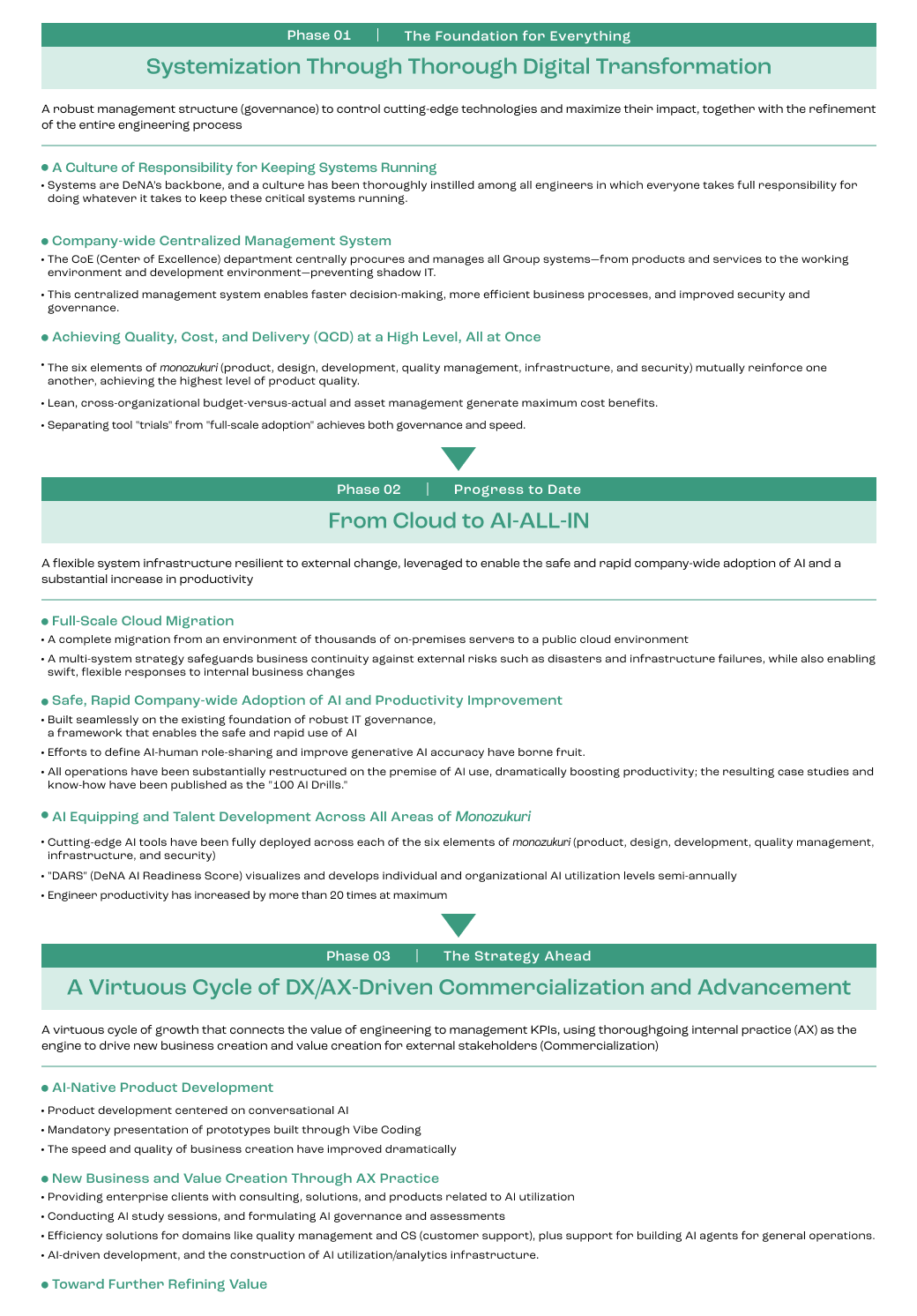
Since its founding, DeNA has consistently engaged in monozukuri (product development) by harnessing cutting-edge IT and AI. Building on a foundation of thorough DX (digital transformation) driven systemization (Phase 01), the company drove a full-scale cloud migration and a company-wide AI-ALL-IN initiative (Phase 02), and is now advancing toward Phase 03: Commercialization—the creation of new businesses and value for external stakeholders—powered by connecting the value of engineering to management KPIs and by thoroughgoing internal practice of AI Transformation (AX). By advancing robust governance, a proprietary data infrastructure, and company-wide AI-native transformation as three pillars, technology is driving DeNA's mid to long term growth.
The foundation built through systemization has translated into business competitiveness through company-wide cloud and AI implementation, and is now bearing fruit in the Commercialization stage. Going forward, DeNA will continue pursuing sustainable growth and new Delight through an IT- and AI-centered technology strategy, while balancing safety and speed at a high level.
Risk Management: AI Utilization and Risk Management
DeNA established the DeNA Group AI Policy (the Policy) on February 24, 2023, and it was released on March 27, 2023.
While the use of AI can greatly contribute to the promotion of the DeNA Group’s business operations, misuse could lead to disadvantages for stakeholders. This policy was designed as a guideline to promote the appropriate use of AI throughout the Group in a safe, secure, and reliable manner, while complying with laws and regulations. By creating a policy based on DeNA’s existing strong IT governance, we have achieved both a sense of speed and a balance with safety and security.
Ensuring Robust Information Security and Privacy Protection
At DeNA, our basic approach for information security is to protect customer information appropriately and ensure the security of the services we provide and our internal systems. Based on this approach, the company strives to provide safe and secure services by establishing and complying with the Group Information Management Standard (GISP) and the Group Information System Standard (GISS), in addition to the DeNA Group Information Security Policy. The security policy is constantly updated to address increasingly sophisticated cyberattacks.
The company has established a Personal Information Management Committee and an Information Security Management Committee to build a cross-group management system. Matters discussed by these committees are regularly reported to management meetings and the Board of Directors and are reflected in important business decisions.
Enhancing Security Measures and Bringing Them In-House
The DeNA Group has introduced security measures based on attack scenarios. We reduce risk by implementing multi-layered measures, including controlling transmissions not required for business, monitoring and analyzing transmissions, responding to vulnerabilities,* secure coding, and encryption of data item by item. Also, to ensure that our workers all abide by and give due consideration to the rules for personal information and security, we conduct education and training appropriate to an individual’s role when they begin work, annually, when they take up a management position, during a period of change in the internal or external environment, and at other appropriate timings.
Vulnerability countermeasures are extremely important for us, as we provide diverse services over the internet. Our in-house security engineers conduct 189 Web/app assessments and network assessments covering 3,632 IPs annually. This extensive track record has led to requests for assessments from outside the company as well.
We also develop our own assessment tools and cloud auto-audit/patch management systems optimized for the Group, with some tools released as open source. We've built systems to quickly analyze and block malware during outbreaks, enabling rapid, flexible responses to threats. To prevent information leaks from cloud misconfigurations, we've also developed a system that automatically monitors AWS and Google Cloud settings daily and alerts us to any errors.
*Vulnerability: A software security flaw caused by a program defect or design flaw.
AI Utilization Governance and Safety Assurance
Regarding AI governance, we are applying the IT system governance structure we have built to date to AI tools as well. In addition to budget/performance and asset management, we also safely manage access, and have established a system that can promptly respond to the vulnerabilities and risks associated with AI’s unique, frequent update cycles.
In the introduction of AI tools, we clearly distinguish between trial usage, which allows immediate implementation and verification of tools under certain rules regarding the information classifications and management systems that should be used, and full-scale use, which is implemented only after a thorough risk assessment, and we have established processes for each. At the trial stage, we begin practical verification based on simple checks. Concurrently, we conduct detailed reviews from legal and security perspectives to control risk while enabling rapid rollout. In this way, we achieve a high degree of balance between swiftly incorporating rapidly evolving AI technology into our business and maintaining company-wide governance.
Indicators and Goals
DeNA has established KPIs for the Materiality in Corporate Capital. For intellectual capital, under the materiality of "Strengthening Technology and Adapting to & Driving New Technology," we are committed to actively using new technologies, including AI technology, both inside and outside the company. We also aim to contribute to the advancement of technology in society by disseminating our knowledge.
At the end of August 2025, we introduced a new index for evaluating AI utilization skills company-wide: the "DeNA AI Readiness Score (DARS)." It is structured around two axes, updated on a semi-annual basis: an "individual level," which measures each employee's level of AI utilization, and an "organizational level," which measures the level of utilization at the organizational level. DeNA had set a goal of having all organizations reach DARS Organizational Level 2 by the end of FY2025; in practice, the achievement rate for Organizational Level 2 or above reached 100%, and the rate for Individual Level 2 or above reached 76%, marking solid results in the very first year.
| KPI | Evaluation Details | Results | |
|---|---|---|---|
| FY2024 | FY2025 | ||
| Number of AI Agent Users | Gemini Advanced MAU *1 | 1,000 people | 1,480 people |
| Employee AI Skill Evaluation | DARS Level 2 or Above (Individual) *2 | - | 76% |
| Organizational AI Skill Evaluation | DARS Level 2 or Above (Organization) *2 | - | 100% |
*1 Refers to Monthly Active Users.
*2 A proprietary AI skill evaluation index developed by the company. Level 2 refers to a level at which "routine use in daily work" is possible.
Contribution to Society through Technology
Since 2015, DeNA has held "DeNA TechCon," an annual technical conference for engineers that shares our technology-related initiatives and challenges, in the hope of contributing to the advancement and evolution of technology in society by making it widely known that we use technology across a wide range of businesses.
In March 2026, we held "DeNA × AI Day 2026" in person, so that not only engineers but also many more people could learn how widely AI is being used. We offered experiences unique to a real-world venue, including presentations that conveyed the energy of the changes brought about by AI together with concrete results, dialogue with engineers working on the front lines, and exhibition booths where visitors could try demos.
In addition, on the DeNA Engineering blog (Japanese), our engineers publish articles on the actual issues they have faced and the technical challenges they have taken on in response, and we also actively participate and speak at external technology conferences.
As an initiative aimed at contributing to the advancement of technology in society, we also offer a program called "DeNA TECH STUDIO." It supports DeNA employees and external engineers in easily holding study sessions on engineering.
In the AI field, as domestic and international conditions and their fluidity grow more intense, our employees also participate in the AI Utilization Strategy Task Force of Keidanren (Japan Business Federation), where we strive to make contributions ahead of the industry, including gathering information on policy and legal matters and making recommendations.
The Group Executive (GEX) responsible for AI promotion participates in bodies such as Keidanren (Japan Business Federation)'s "AI Utilization Strategy Task Force" and the Agency for Cultural Affairs' "Network of Stakeholders on AI and Copyright," engaging in communication with relevant ministries and agencies, including the Ministry of Economy, Trade and Industry, the Cabinet Office, IPA (Information-technology Promotion Agency, Japan), the Agency for Cultural Affairs, the Japan Fair Trade Commission, and the Personal Information Protection Commission. Through these forums, we keep abreast of AI-related laws and regulations as well as domestic and international developments, while also engaging in activities such as policy recommendations aimed at practical application.
In addition, by maximizing the synergy between our unique and diverse business operations (a strength of ours) together with the application of AI to them, and our design and solution development capabilities (another of DeNA's strengths), we aim to become a leading company in AIUX*, a field not yet established in Japan. We are also actively sharing our AI-related technologies and insights, both inside and outside the company, through academic conferences, tech events, blogs, and other channels.
*Maximizing the user experience and value in the course of developing AI solutions