
Respect for Human Rights
Basic Policy
“We delight people beyond their wildest dreams” is the mission of the DeNA Group. By working appropriately with a variety of stakeholders, the DeNA Group aims to deliver diverse forms of Delight and broadly contribute to society.
The DeNA Group Code of Conduct also sets forth a basic stance of promoting co-existence and co-prosperity, respect for diversity, and sustainable corporate activities. Furthermore, it stipulates that the Group shall conduct its business operations with respect for the fundamental human rights of all people and with consideration for regional and cultural differences and diversity.
Based on the above, the DeNA Group has formulated the “DeNA Group Human Rights Policy” (hereinafter the “Policy”) as the guideline promoting respect for human rights throughout the DeNA Group, and the Policy was adopted through a board of directors resolution.
This Policy supports and is based on international human rights norms, including the Universal Declaration of Human Rights (International Bill of Human Rights), the ILO Declaration on Fundamental Principles and Rights at Work, and the Guiding Principles on Business and Human Rights, and it applies to all officers and employees of the DeNA Group.
In addition, we are working to ensure that human rights are respected not only in our own business activities but also throughout our value chain, including business partners, suppliers, and other trading partners. We have established the "DeNA Group Partner Guidelines," which clearly state the matters on which we ask our partners for cooperation in our transactions, such as "respect for human rights and consideration for diversity" and "prohibition of harassment and discrimination, and equal opportunity," and we promote efforts to respect human rights in collaboration with our stakeholders. In advancing these efforts, we strive for continuous improvement while receiving advice from external experts.
Related links
DeNA Group Partner Guidelines
Education and Training for Employees (Compliance Training)
Whistleblowing hotline
AI Policy
Governance Structure and Oversight Responsibility
The Board of Directors bears supervisory responsibility for the DeNA Group's efforts to respect human rights. Based on its basic policy on sustainability-related initiatives and its recognition of risks and opportunities, the Board of Directors oversees policies and measures concerning sustainability, including human rights.
These policies and measures are promoted with the CEO, who serves as the director in charge of sustainability, at the center, starting from the prevention and mitigation of adverse impacts on the human rights of the people involved in our business activities (stakeholders). Day-to-day responsibility and resources for promotion are clearly assigned to the compliance and risk management department, which oversees the company-wide risk management process. In collaboration with each business unit and the human resources department, this department leads the identification and assessment of human rights risks and corrective measures. The status of these efforts is managed in line with the company-wide risk management process, and we have established a system to promptly report to the Management Meeting and the Board of Directors when a significant matter arises.
Human Rights Due Diligence Initiatives
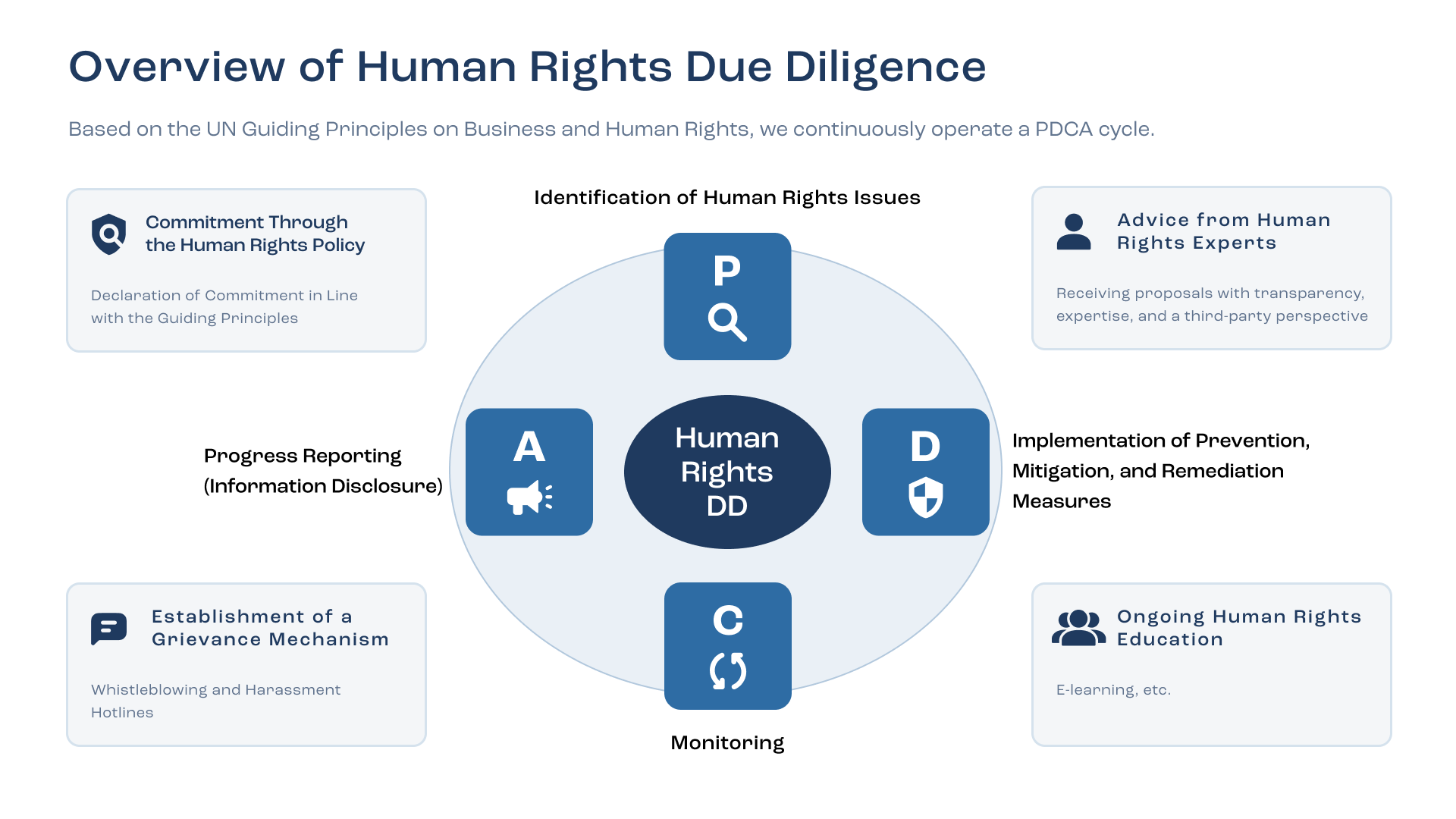
Based on the UN Guiding Principles on Business and Human Rights, the DeNA Group has established and operates a human rights due diligence process to identify, assess, prevent, and mitigate adverse impacts on the human rights of stakeholders affected by our business activities.
Specifically, we continuously run a cycle of 1) identifying and assessing adverse impacts → 2) preventing and mitigating adverse impacts → 3) assessing the effectiveness of our efforts (monitoring) → 4) disclosing information to stakeholders. To date, we have conducted human rights risk assessments and identified key human rights issues, and we are currently working with each business division to consider measures, KPIs, and targets for the top-priority human rights issues we identified.
Human Rights Risk Assessment (Identifying Salient Human Rights Issues)
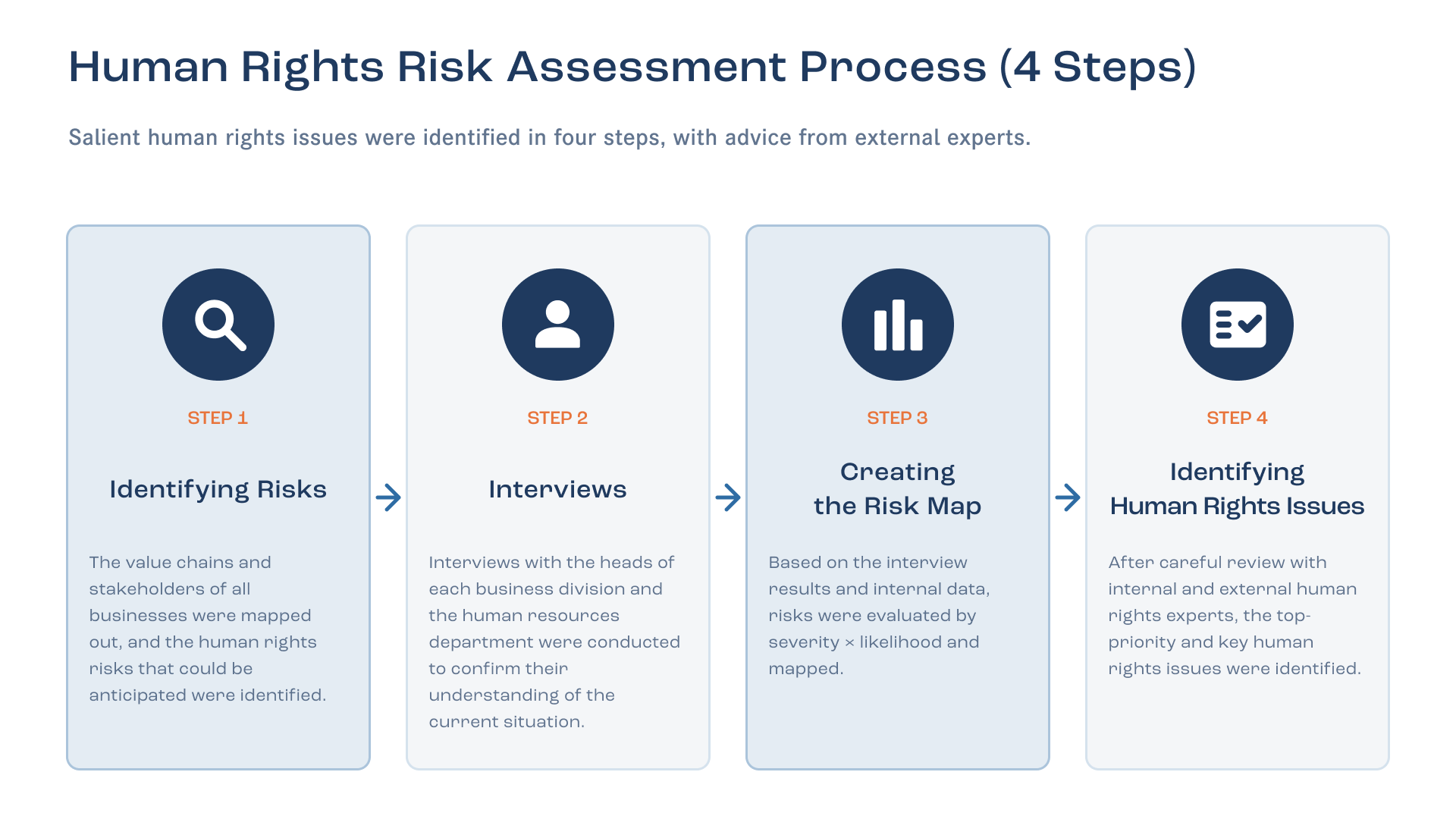
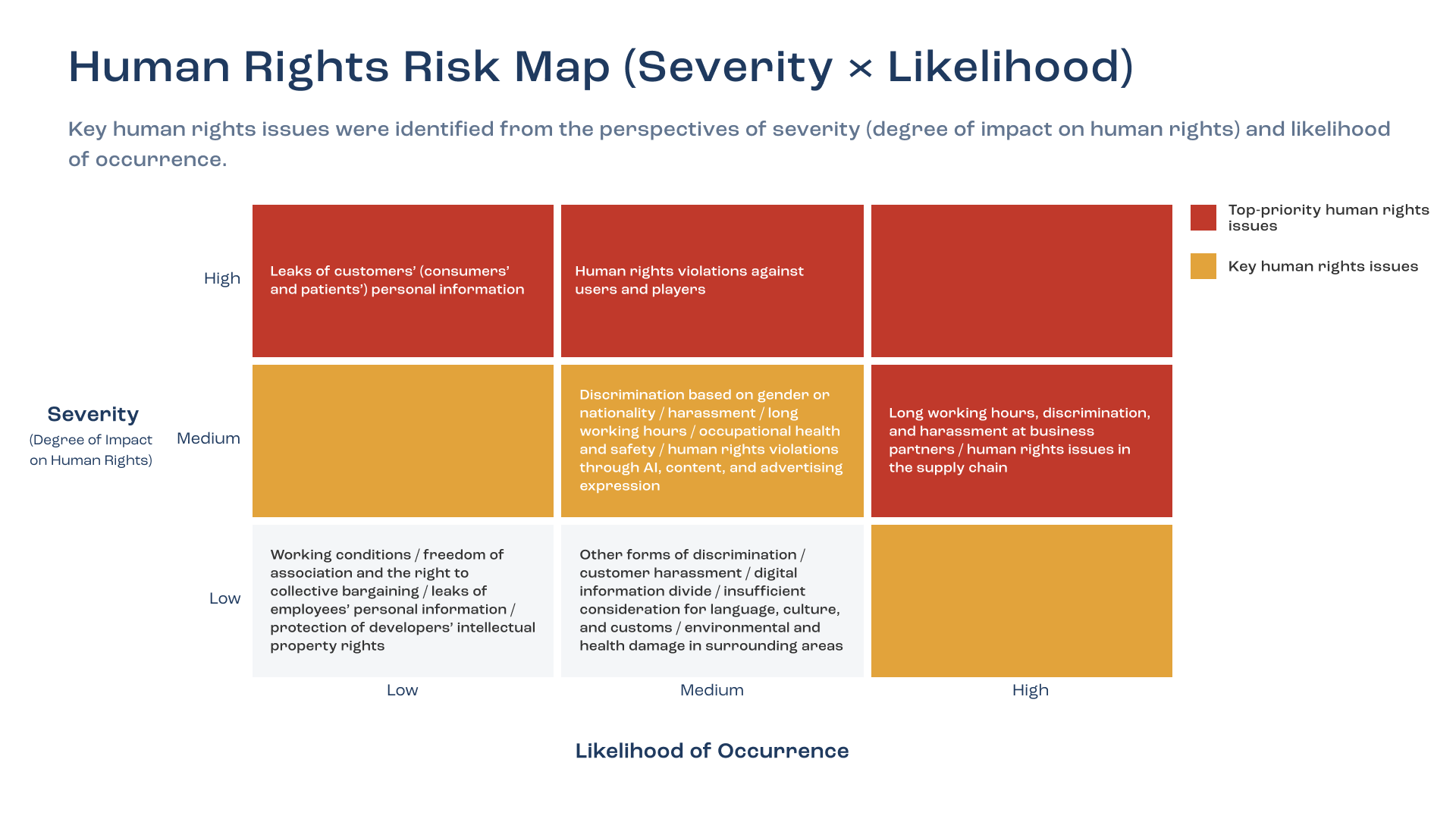
With advice from external experts, the DeNA Group assessed human rights risks in the following four steps and identified the salient human rights issues specific to the Group (top-priority human rights issues and key human rights issues).
- Step 1: For all businesses of the DeNA Group, we mapped out each business's value chain and stakeholders and identified the human rights risks that could be anticipated.
- Step 2: We conducted interviews with the heads of each business division and representatives of the human resources department to confirm their understanding of the current state of human rights risks and the initiatives underway in each business.
- Step 3: Based on the interview results and internal data, including data on business partners, and taking the characteristics of each business into account, we evaluated the severity (scale, scope, and irremediable character) and likelihood of human rights risks and created a "human rights risk map."
- Step 4: Based on the human rights risk map, and after careful review with internal and external human rights experts, we identified the key human rights issues (top-priority and key human rights issues) for our Group.
Initiatives for Key Human Rights Issues
For the top-priority and key human rights issues identified through the human rights risk assessment, we are working with each business division on specific initiatives to avoid, prevent, and mitigate them.
① Human rights of business partners (supply chain)
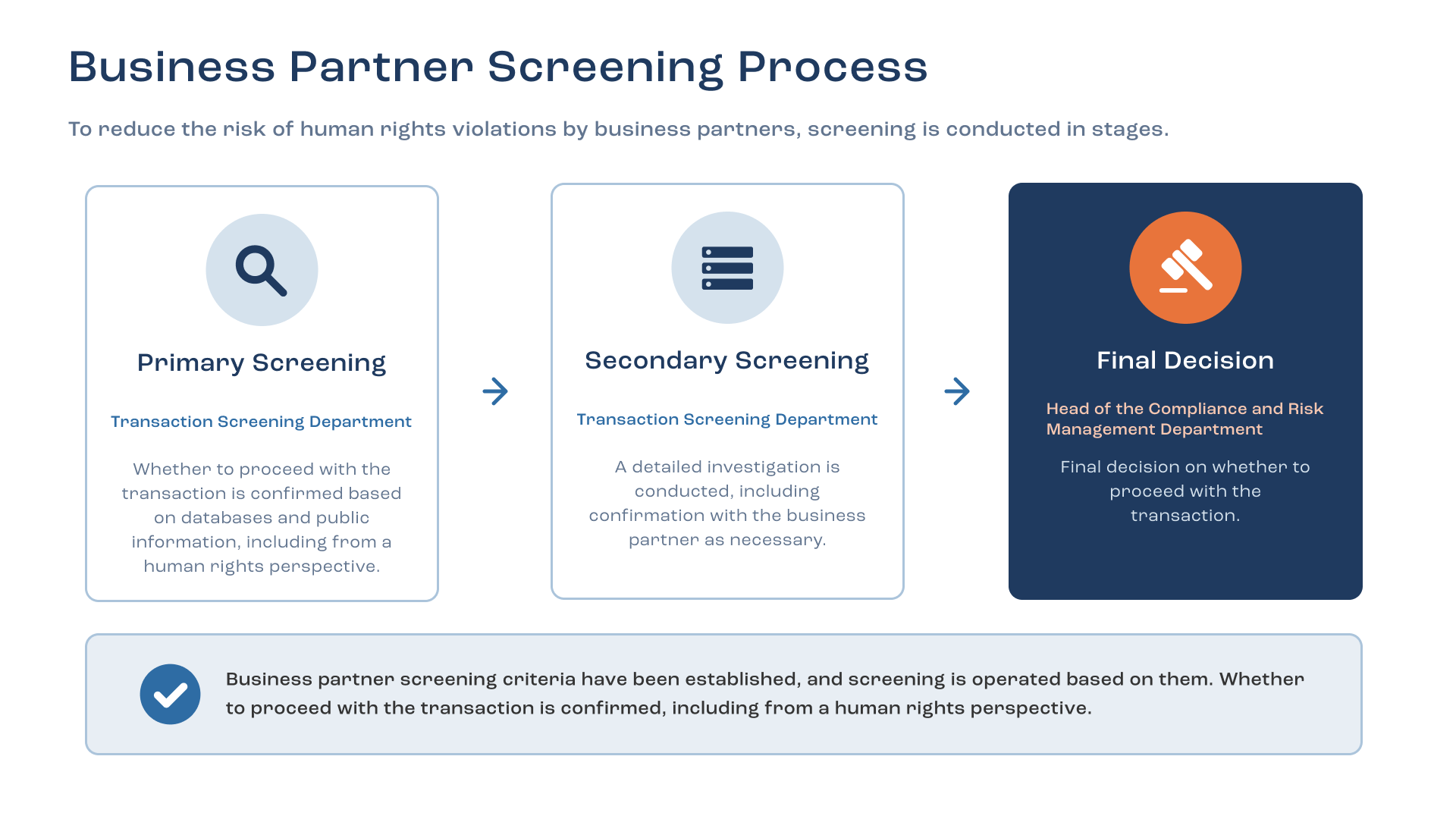
To reduce the risk of human rights violations by business partners, we have established business partner screening criteria and conduct screening based on them. At the start of a transaction, the transaction screening department conducts a primary screening, in which it determines whether to proceed with the transaction based on databases and public information, including from a human rights perspective. If further scrutiny is judged necessary, the department conducts a secondary screening, in which it carries out a more detailed investigation, evaluates the partner based on databases and public information, and, as necessary, confirms matters with the business partner. In the end, we ensure a process in which the head of the compliance and risk management department makes the final decision on the transaction.
In addition, for existing business partners, based on transaction data from all Group businesses, we conducted screening to identify business partners with a high human rights risk along two axes: influence (transaction scale) and severity (nature of the transaction). The results will be used as basic material for prioritization in future due diligence.
② Protecting the human rights of users and players
In the internet services field, we position protecting an environment in which users can use our services safely and securely as part of our efforts to respect human rights. To protect users from defamation, discriminatory posts, and illegal or harmful information, we implement the optimal measures for each service, such as monitoring through human visual checks and systems. We are also working to create age-appropriate usage environments so that young people can use our services safely.
In the sports business field, to protect the human rights of everyone involved in sports, including players and coaches, students at sports schools and academies, and operating staff, we position "sports harassment" as a salient human rights issue tied to the characteristics of our business and are working on company-wide structural development, training, and other measures. In particular, we place emphasis on protecting the safety and healthy growth of children attending schools and academies, and are advancing initiatives that incorporate the perspective of child protection (safeguarding).
As a concrete action, in September 2026 we established a common CREDO for the DeNA Sports Schools and Academies. As a practical example, at the S.C. Sagamihara school, we have built a comprehensive safeguarding system that includes training for instructors, the formulation of a code of conduct, the establishment of a consultation contact, and the collection of consent forms from the people involved and we are promoting the creation of an environment where everyone can participate in sports with peace of mind, both physically and mentally.
Initiatives to Ensure Safe and Secure Use of Our Services
DeNA Sports Schools and Academies Common CREDO (Japanese only)
③ Protection of customers' personal information
The DeNA Group regards the protection of personal information entrusted to us by customers as one of the most important management issues and has set out its appropriate protection in its basic policy on information security. Under this policy, we have established the "DeNA Group Information Security Policy" and the "Group Personal Information Management Guidelines" and manage the handling of personal information from acquisition through disposal. We have also established a Personal Information Management Committee, chaired by the Representative Director and President, to build a Group-wide structure, and we provide training on personal information and information security to all officers and employees.
Information Security
④ Respect for diversity and prohibition of discrimination
We strive to ensure thorough awareness that a variety of factors, including race, nationality, religion, and gender, as well as age, sexual orientation, physical or mental disabilities, and marital or child status, can lead to discrimination and harassment. We do so through the Compliance Handbook, which explains specific examples, Code of Conduct training and human rights training for all officers and employees, and training on unconscious bias.
⑤ Prevention of harassment
The Group Code of Conduct stipulates that all forms of harassment, including sexual harassment, are not tolerated. We work on prevention and early response through e-learning training for all employees, training for newly appointed managers, and the establishment of consultation contacts.
⑥ Prevention of long working hours and occupational health and safety
Based on the Group Code of Conduct, we ensure a healthy and safe working environment for all officers and employees. We manage working hours appropriately and work to prevent long working hours. We have also established a Safety Policy, Occupational Health and Safety Management Regulations, Health Committee Regulations, and other rules, and we strive to create an environment where officers and employees can work with peace of mind in a comfortable workplace. For work in conflict zones and similar areas in the medical business, matters concerning business travel to hazardous areas are specified in the Regulations on Overseas Assignees and Subsidiary Management and other rules, and operational manuals are created and communicated through the internal portal.
Work Environment and Health / Management of Occupational Health and Safety
⑦ Addressing human rights violations arising from AI
We have established the "DeNA Group AI Policy" and are promoting the appropriate use of AI throughout the Group so that, even when using AI, we respect the fundamental human rights of all people, pay attention to fairness, and avoid discrimination and unfair treatment.
DeNA Group AI Policy
⑧ Consideration of human rights in content and advertising
We have established internal guidelines on expression so that our content and advertising do not promote discrimination or prejudice. Going forward, we will enhance our consideration of human rights in content and advertising, including by further reflecting the perspective of respect for human rights.
Remedy Mechanisms and Status of Human Rights Violations
To identify human rights issues (discrimination, harassment, working conditions, etc.) at an early stage and respond appropriately, the DeNA Group has established reporting hotlines available not only to officers and employees but also to external stakeholders such as business partners. We ensure thorough protection for whistleblowers by allowing anonymous reporting and prohibiting any disadvantageous treatment or retaliatory measures against them.
Should it be found that we have caused or contributed to an adverse human rights impact through our business activities, we will promptly investigate the facts and take remedial and corrective measures for the affected parties. In addition, we continuously work to prevent human rights violations and reduce risks through employee surveys, internal audits, and monitoring of the reporting hotlines. No serious human rights violations attributable to our business activities occurred during the reporting period.
The number of reports received through the hotlines and the status of our responses are described in the "Compliance" section of our sustainability site.
Compliance
Future Initiatives
The DeNA Group will advance its consideration of measures, KPIs, and targets for the key human rights issues we have identified, and will periodically and continuously review its human rights risk assessments in light of changes in the business environment and the results of dialogue with stakeholders. In this way, we will continue to operate the human rights due diligence cycle and improve the effectiveness of our efforts.